

Resources
The CSTN will share resources, research and toolkits to align strategies, best practices and develop a community of practice that supports the transformation of shelters across Canada to become housing focused.
(Check back here as we will update this page regularly.)
CSTN Shelter Transformation Manual & Self-Assessment
CSTN Webinars
See past and upcoming webinars from CSTN offering further guidance on how to transform to a housing-focused shelter system.
Webinars from 2019 to present can be found on the CSTN Webinar page.
Housing-Focused Shelter Information, Tools and Community Examples
Diversion
- See Diversion information and resources on the Built for Zero Canada website
Intake
- Coming soon
Self -Directed and Staff Engaged Rapid Resolution
- Self-Directed and Staff Engaged Rapid Resolution – Part 1, Part 2 (Webinar – 90 min) – Rapid Resolution is a housing intervention designed to immediately resolve a household’s homelessness once they enter shelter. This session reviews how service providers can engage shelter residents in deliberate, thoughtful and individualized conversations that seek to solve their immediate housing crisis.
- Region of Waterloo Renter’s Toolkit – If you are working with someone experiencing homelessness to find a place to rent, this guide can help you search for and secure housing.
- Housing Action Plan – It is a collaborative tool for shelter staff and guests to navigate the housing search process together. It provides clear steps, realistic goals, and essential resources to support a successful transition
from shelter to stable housing. - Housing Search Log – It is a tracking tool for shelter staff and guests to document progress in securing rental housing. It helps organize apartment listings, track inquiries, applications, and follow-ups, ensuring a structured and efficient search process.
- Housing Preference List – This tool helps shelter staff and guests identify and prioritize housing needs and preferences. It can help staff and guests outline key factors like location, affordability, and amenities.
- Common Housing Start-Up Items – This form helps shelter staff and guests identify essential items needed for a successful move into a new home. By outlining key household necessities, this tool ensures a smooth transition, promotes preparedness, and helps coordinate resources to create a stable and comfortable living environment.
Coordinated Entry/By-Name Data
- See Coordinated Entry and By-Name Data information and resources on the Built for Zero-Canada website.
- By Name Data, Coordinated Entry & Getting Shelter Guests ‘Document Ready’ Recording and Presentation Slides (2024) – By-Name Data and Coordinated Entry (aka Coordinated Access) are vital components to any system that aims to end homelessness. This webinar provides an introduction to these components, and addresses the important link between them and emergency shelter providers
- Document Ready Checklist for Shelters – Being ‘document ready’ means having the essential documents – such as ID, income verification, and housing history – that landlords and housing programs require. This sample checklist supports shelter staff and guests to track what is in place, identify what’s missing, and take steps to secure the right documents so people can into housing more quickly (through Coordinated Entry or outside of it).
- Document Readiness Tracking Spreadsheet – This Excel tool helps shelter staff track multiple guests’ progress in becoming document ready -all in one place. It allows staff to see at a glance which documents are complete, which are still outstanding, and the dates of completion. The spreadsheet includes separate tabs for families, individual adults, and youth, making it easy to organize and monitor progress across different groups.
Building community support tools
- Dear Neighbour Poster (Siloam Mission – Winnipeg, MB) – This neighbourhood poster provides surrounding residents with clear contact information and guidance on who to reach out to when certain situations or concerns arise near the shelter, helping strengthen communication and community safety.
- Media Toolkit (End Homelessness Winnipeg) – Developed to empower media with facts and guidelines for reporting on homelessness, human rights can be better protected, and the public interest can be better served.
- Outreach Door Knocker (Main Street Project – Winnipeg, MB) – This doorknocker introduces their Mobile Outreach Team, provides contact details, and explains how neighbours can connect with the team to support unsheltered community members and strengthen local relationships.
OTHER HELPFUL MATERIALS
- Amnesty Tote Procedure (sample) – This procedure outlines a structured approach for guests to safely store personal belongings without judgment, while supporting shelter operations in maintaining safety, organization, and accessibility. It is intended as a reference or starting point for shelters considering the adoption of an amnesty tote system.
- Search Procedure (sample) – This procedure outlines clear steps when conducting a search of a shelter guest’s personal belongings in a manner that aims to ensure safety and security while respecting the dignity and rights of shelter guests. It is intended as a reference for shelters developing or refining their own search protocols.
- Drug Poisoning Response (sample) – This response outlines immediate response steps, staff roles and additional actions when responding to a suspected or confirmed drug poisoning within an emergency shelter. it is intended as a reference or starting point for shelters developing or updating their own drug poisoning response protocols
Emergency Shelter Frameworks and Standards Examples
- Newfoundland Shelter Standards (2024)
- Ottawa Emergency Shelter Standards (2021) & Council Report
- BC Housing Emergency Shelter Program Framework (2018)
- BC Housing Shelter Design Guidelines (2017)
- Waterloo Region Emergency Shelter Program Framework (2017) & Summary & CAEH17 Presentation
- Alberta LGBTQ2S Housing and Shelter Guidelines (2017)
- Toronto Shelter Standards (2015)
- City of Edmonton Emergency Shelter Best Practices Guide (2024)
Ending Homelessness for People in Encampments
Considerations and Tools to Respond Effectively
- Integrating Health Care San Diego County, California
- Engaging Neighbors and Businesses Las Cruces, New Mexico
- Housing-Focused Outreach Hennepin County, Minnesota
- Engaging Encampment Residents in Solutions Denver Colorado
- Webinar Recording and Slides for USICH’s 19 Encampment Strategies: A Conversation With Communities | United States Interagency Council on Homelessness (June 2024) – In this interactive 1-hour webinar, the U.S. Interagency Council on Homelessness (USICH) provide a brief overview of USICH’s 19 Strategies for Communities to Address Encampments Humanely and Effectively.
- Ending Homelessness for People Living in Encampments in Canada Toolkit (OrgCode, March 2022) – this toolkit was commissioned by the Canadian Alliance to End Homelessness with the intention of giving communities tools for a housing-focused, rights-based approach to ending homelessness for people living in encampments.
- Encampments Webinar (hosted by CAEH and presented by Orgcode, April 2024)
- Encampments Webinar Series (hosted by CAEH and presented by Orgcode, Fall 2020)
- Fact Sheet: New US Initiative to Tackle Unsheltered Homelessness (May 2023) – ALL INside, a key component of the Federal Strategic Plan to Pevent and End Homelessness (2022) in which USICH and its 19 federal member agencies will partner with state and local governments to strengthen and accelerate local efforts to get unsheltered people into homes in six places: Chicago, Dallas, Los Angeles, Phoenix Metro, Seattle, and the State of California. An example of a comprehensive and coordinated approach to ending homelessness for people in encampments.
- BC Encampment and Homelessness Response – HEART & HEARTH – BC Housing is working with partners to provide people living outdoors and in encampments with better access to a range of support services, new shelters, and housing options through new programs funded by the Province under the Belonging in BC Homelessness Plan: Homeless Encampment Action Response Team (HEART) and the Homeless Encampment Action Response Temporary Housing (HEARTH).
- Seven Principles for Addressing Encampments (USICH, June 2022) – a six page document with links to further resource
- Protecting the Health and Well-being of People in Encampments and Other People Who Access Public Spaces (HUD, June 2022) – a five-page document outlining four key steps to developing and implementing an inclusive public space management strategy.
- What Other Cities Can Learn from Boston’s Public Health Approach to Homelessness (UISCH Blog, June 2022)
- Responding to the Growing Crisis of Unsheltered Homelessness and Encampments (UISCH Blog, May 2022)
- Ending Homelessness for People Living in Encampments: Advancing the Dialogue (USICH, 2015) – report and materials designed to assist communities in developing an action plan that will link people experiencing homelessness and living in an encampment, with permanent housing opportunities:
- Ending Homelessness for People Living in Encampments: Advancing the Dialogue Report – includes PDF of a Quick Guide and Planning Checklist
- Chatham Kent’s Homelessness Response Toolkit – Reach Out Chatham-Kent (R.O.C.K.) has created a Homelessness Response Toolkit to help businesses, BIAs, and community members better understand homelessness and respond with compassion. The goal is to reduce stigma, provide clear guidance, and encourage supportive interactions with people experiencing homelessness
Community Examples of Housing Focused Responses
- Peterborough from Encampment to Bridge Housing (April 2024) – Recording and PDF
- Compassionate decampment: lessons from Oppenheimer Park (CAEH, March 2024)
- Bright Spot: How Fort McMurray resolved an encampment without enforcement (CAEH, Jan 2024)
- A Tale of Two Tent Cities: The Critical Role of Housing Engagement in Addressing Homeless Encampments (US, Spring 2023) – a 32 page Georgetown Journal on Poverty Law and Policy article. Using the experience of Gainesville, Florida as a case study, this rticle summarizes the outcomes achieved with the housing engagement approach. Includes appendixes with Transitional Campground Expectations and Closure Procedures
Winter Interim and Extreme Weather Response Plans
us hud resources for winter sheltering and cold weather response (Generally and during covid)
- Winter Response Planning – Recording and PDF
- Winter Planning Guide Overview: Meeting Winter Shelter Needs and Mitigating Health Risks – helps communities engage critical partners, project winter sheltering capacity needs, create a Winter Emergency Plan to meet escalating levels of shelter demand and consider alternative approaches to winter sheltering, and prevent the spread of COVID-19 in winter shelter facilities.
- How to Complete the Winter Emergency Plan Planning Guide and Template – guides communities through identifying resources needed to effectively respond to three levels of escalating winter sheltering needs.
- Alternative Approaches to Winter Sheltering During COVID-19 – provides a graduated approach to sheltering from life-threatening temperatures and regular seasonal weather.
- Winter Response Activation and Communications Planning Guide and Template – provides a set of key decision points to help communities define what triggers a winter emergency response and how weather alerts are communicated to key stakeholders.
- COVID-19 Preparedness Checklist for Shelter Facilities – provides a series of checklists designed to help providers implement strategies for mitigating the spread of COVID-19 in winter facilities.
Sample canadian extreme weather response plans from communities
-
- Fraser Health Toolkit for Extreme Heat and People Experiencing Homelessness – provides tools and resources related to extreme heat response for those who work with people experiencing homelessness or in low-income buildings.
- Saskatoon’s Cold Weather Strategy (2021)
- Saskatoon’s Extreme Weather Strategy (2021)
- Toronto Winter Services Plan for People Experiencing Homelessness
- York Region 2023/2024 Cold Weather Response Plan for People Experiencing Homelessness
- York Region Heat Relief Strategy for People Experiencing Homelessness
Domestic and Sexual Violence – Emergency Shelter Considerations
- Safely Serving Families and Victims of Domestic Violence (NAEH 2018 webinar – 90 min) Download slides
- Safety Planning for Survivors of Domestic and Sexual Violence: A Toolkit for Housing Programs (NASH, 2018)
- Safe Housing Partnerships– the website for the Domestic Violence and Housing Technical Assistance Consortium. Find useful resources and tools that advance your work at the critical intersection of domestic violence, sexual assault, homelessness, and housing.
- Housing, Homelessness and Violence Against Women (Women’s Shelters Canada, 2017)
- Trauma and Violence Informed Care (TVIC): An Orientation Tool for Service Providers in the Homeless Sector (Public Health Agency of Canada, 2019)
- Gender Integrated Shelters: Experience and Advice (FORGE, 2016)
- Safety and Privacy Consideration When Using Hotels for Shelter Stays (NNEDV, 2013)
- See also, Partnering with Other Systems – Domestic Violence
Emergency Shelter Bright Spots, Books and Other Resources
- Building a Better Life: Determinants of Social Capital and Differential Success -This SSHRC research project, completed in 2018 in Edmonton, AB, looks at how to measure Social Capital quantitatively.
- Complex Needs Banning Research Project – This community-based research project was conducted in partnership with the Complex Needs Committee of Edmonton, a group of shelter service providers that meet regularly to discuss trends and identify gaps and potential solutions to issues arising within the sector.
- Homelessness is a Housing Problem: How Structural Factors Explain U.S. Patterns (Gregg Colburn & Clayton Page Aldern, University oof California Press, 2022) – This groundbreaking book explains why homelessness has become a crisis in America and reveals the structural conditions that underlie it.
- The Book on Ending Homelessness (Iain De Jong, OrgCode, 2019)
Refer to Chapter 3 on Emergency Services: Shelters Outreach, and Day Services. - Calgary Drop-In Center Bright Spot (CAEH, 2019)
- Beyond Shelters – CAEH Blog on new book by James Lorimer & Co (2018)
- Harm Reduction and Shelters: A Jurisdictional Scan of Harm Reduction Initiatives In Canadian Shelters (2018)
- How Our Shelter Began Focusing on Permanent Housing and Started Ending Homelessness for Our Clients (2014) – describes how one shelter run by Northern Virginia Family Service shifted to a housing-focused model.
- Housing Focused Shelter Training – (training video – 46 min) – Courtesy of Siloam Mission Winnipeg
- Behaviour Based Model for Shelters (training video – 48 min) – Courtesy of Siloam Mission Winnipeg
- The Shelter Safety Study: An examination of violence and service restrictions in Toronto’s shelter system (2024) – CAMH Final Report
National Alliance to End Homelessness Emergency Shelter Learning Series
- NAEH Website (with all resources below)
Blog
- Would Adding More Emergency Shelter Help Reduce Unsheltered Homelessness? Its Complicated… (Aug. 2018)
- To Address Unsheltered Homelessness, Shelter and Housing Must Be Connected (July 2018)
Webinars & Tools
Overview & Self-Assessments and Action Plans
- The Role of Emergency Shelter in a Crisis Response System (webinar – 55 min) Download slides and tools:
- Self-Assessment Online Survey – follow-up action plans:
- System Role Self-Assessment and Action Plan
- Housing First Self-Assessment and Action Plan
- Diversion Self-Assessment and Action Plan
- Low-Barrier Self-Assessment and Action Plan
- Housing-focused and Rapid Exit Services Self-Assessment and Action Plan
- Using our Data Self-Assessment and Action Plan
Low Barrier Shelters
- Low Barrier Shelter Videos – Four 2-min videos (2018)
- The Keys to Effective Low-Barrier Emergency Shelters (webinar -55 min) Download slides
- How to Transition Your Shelter to Low-Barrier and Housing-Focused (webinar – 90 min) Download slides
- Frequently Asked Questions for Low-Barrier Shelters (webinar – 90 min) Download slides
- Rules and Safety in Serving Adults in Low-Barrier Shelters (webinar – 90 min) Download slides
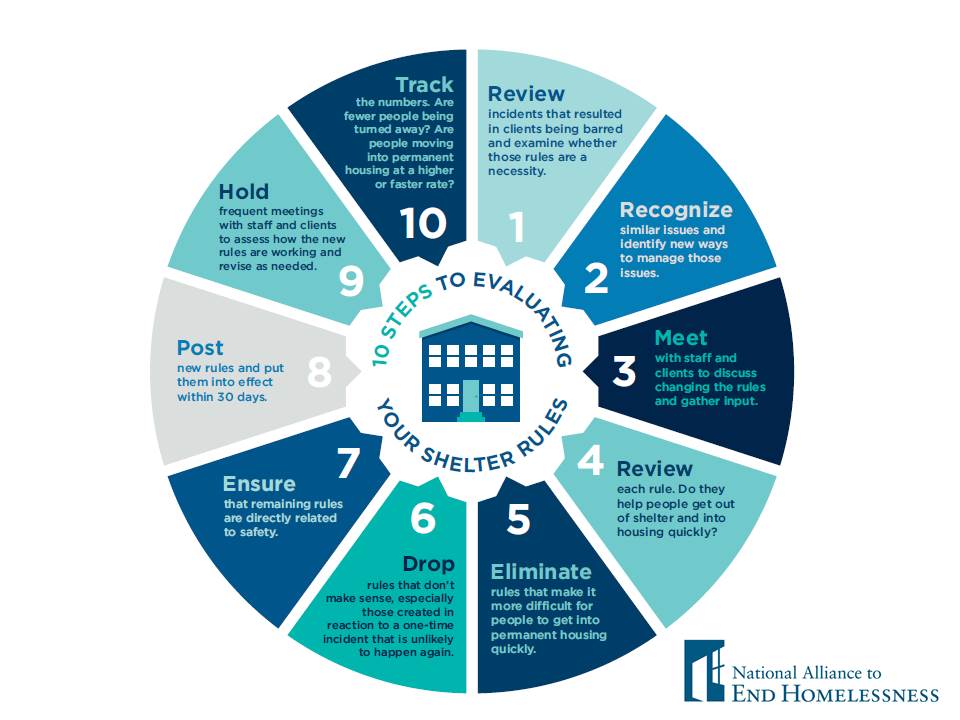
- 10 Steps to Evaluating Your Shelter Rules
- Changing Punitive Shelter Rules to Simple Community Expectations (Blog – Feb. 2018)
- Getting Your Board on Board with Low-Barrier, Housing-Focused Shelter (webinar – 60 min) Download Slides and tools:
- How to Get Your Board Ready for the Shift to Low-Barrier, Housing-Focused Shelter Guide
Role of Emergency Shelter in Diversion
- Role of Emergency Shelter in Diversion (webinar – 90 min) Download Slides and tools:
- Key Takeaways: The Role of Emergency Shelter in Diversion
- Diversion Self-Assessment Action Plan
Safety Serving Families and Victims of Domestic Violence
- Safely Serving Families and Victims of Domestic Violence (webinar – 90 min) Download slides
Using Data
- Using Data to Evaluate and Improve (90 min) Download slides and tools:
- Using our Data Self-Assessment and Action Plan
- Shelter Outcome Metrics Form
Equal Access
- HUD’s Equal Access Rule (webinar – 90 min) Download slides and tools:
- Equal Access Self-Assessment for Shelters and Housing Projects
- Equal Access Decision Tree: Supporting Equal Access Across the Full Spectrum of Services
- Equal Access for Transgender People Supporting Inclusive Housing and Shelter
- Equal Access Expectations Training Scenarios
Pet Friendly
- How to Become Pet Friendly (webinar – 60 min) Download slides and tools:
- Ten Lessons from the Field on Operating Pet-Friendly Shelter
- Sample Guidelines for Emergency Shelters that Welcome Service/Emotional Support and Other Animals
- Pets Can Be an Open Door to Ending An Individual’s Homelessness ( Blog – Nov. 2018)
United States Interagency Council on Homelessness – Shelter Resources
- Low Barrier Emergency Shelter Podcast (USICH, 2019) – 11 mins
- Implementing Effective Emergency Shelter Checklist (USICH, 2018) – 2 pages
- Emergency Shelter Key Considerations (USICH, 2017) – 10 pages with links to other resources
- How Health Systems and Hospitals Can Help Solve Homelessness – (USICH, 2024) Webinar Recording – During this session, USICH—which sets federal homelessness strategy—discussed its recent guidance, “How Health Systems and Hospitals Can Help Solve Homelessness,” outlining effective strategies for compassionate and collaborative care for people without safe, stable housing.
National Health Care for the Homeless Council – Health in Shelters
- Canadian Network for the Health and Housing of People Experiencing Homelessness (CNH3) – resources page (website link to resources page)
- Improving Indoor Air Quality To Reduce Disease Transmission in Congregate Spaces (Homeless Hub Blog, March 2021)
- Shelter-Based Care for Homeless Populations (2018) – innovative shelter-based health care programs
- Making the Connection: Improving the Relationship Between Shelters and Health Centers – webinar (2018) – Watch the Recording & View Slides (PDF)
- Shelter Health: Opportunities for Health Care for the Homeless Projects (2016) – issue brief identifies certain health issues that can be particularly affected by shelter conditions and identifies opportunities for health centers to be engaged in local efforts to improve shelter health.
- Health in Shelters (2006) PowerPoint presentation by Bob Donovan, MD, Cincinnati Health Network, Inc. Focuses on communicable diseases and general prevention measures.
- Shelters and TB: What Staff Need to Know, Second Edition (2013) – the Curry International Tuberculosis Center video and viewer’s guide.
- Pandemic Influenza Guidance for Homeless Shelters & Homeless Service Providers (2009) This practical manual is for homeless shelters and other service providers as they plan for and respond to the special needs of homeless individuals during the influenza season.
OrgCode Emergency Shelter Resources and Blogs
Documents on Shelter
- An Introduction to Low Barrier Housing Focused Shelter (Mar. 2022)
- Housing-Focused Shelter Sample Daily Operating Policies and Procedures
- Person-Centred and Trauma-Informed Considerations in a Housing-Focused Shelter (OrgCode & Calgary Drop-In Centre)
Blogs on Shelter
- Service Restrictions and Barring in Shelters (Mar. 2019)
- Staff Change as the Shelter Changes (Feb. 2019)
- 8 Tips to Add More Harm Reduction Practices to Your Shelter (Nov. 2018)
- So You Think You are a Low Barrier Shelter… Let’s Check (Sept. 2018)
- 1 Needs 6 (Feb. 2018)
- Unique Individuals and Length of Stay (Jan. 2018)
- Housing Focused Shelter (Dec. 2017)
- Car Dealerships and Homeless Facilities (Sept. 2017)
- Signs of a Bad Shelter Proposal (Feb. 2017)
- 10 Critical Questions for Every Shelter and Shelter System (Feb. 2017)
- Designing an Amazing Shelter (July 2016)
Pets and Shelters – Pets and Ending Homelessness
- Pet-Friendly Shelter Policy & Supporting Documents (Region of Peel, 2025) – A policy and practical documents to support low-barrier, pet-inclusive shelters. Includes policy guidance, intake forms, staff checklists, and safety protocols to help shelters accommodate people with pets while maintaining health, safety, and dignity.
- Community Veterinary Outreach – A Canadian charity with a mandate to improve the health of homeless and vulnerably housed communities through veterinary care to their pets, and to connect their humans with health and social services
- Housing for All Includes Housing for Our Pets (On The Way Home Podcast, 2024 – 27 min) – Ashley Travis, from the PEI Humane Society talks about the challenges in her province around housing vulnerable individuals whose families include pets and some of the things their organization is doing to support individuals going through this experience.
- Animal Companions in Affordable Housing and Shelters (On The Way Home Podcast, 2023 – 40 min) – 3 leaders from Humane Canada, discuss their impactful ACT Project that seeks to address systemic barriers for women with animals (companion, farmed, and service) experiencing gender-based violence, including affordable housing and shelter.
- Pets as Gateway to Caring for Community (COH Blog, 2017)
- Homeless Canadians Take Good Care of Their Pets (Study, 2021)
- Co-sheltering With Companion Animals Is Essential During COVID-19 and Beyond (NAEH Blog, March 2021) – This blog includes links to My Dog is My Home non-profit, Keeping People and Pets Together and many other resources. It also includes information about the first Co-Sheltering Conference taking place in March 2021
- How to Become Pet Friendly (webinar – 60 min) Download slides and tools:
- Ten Lessons from the Field on Operating Pet-Friendly Shelter
- Sample Guidelines for Emergency Shelters that Welcome Service/Emotional Support and Other Animals
- What Can Be Done to Better Support People Experiencing Homelessness with Pets (Blog – Dec 2020) – with links to more resources
- Pets Can Be an Open Door to Ending An Individual’s Homelessness ( Blog – Nov. 2018)
- Pets and Sheltering Guidelines During COVID-19 (Co-sheltering Collaborative website)
- Canadian Community Examples:
- Toronto Pet Services for Homeless Shelters (City of Toronto website)
- Waterloo Region Pop-Up Vet Clinic – low cost/free vet clinic to assist the pets of people experiencing homelessness and their owners. See news article and Human Society article